
Hey, we get a new Spiderman movie every 3ish years right? If we have to deal with that, I think it’s a fair trade off every 1-2 generations we get a new movie about the Nuremberg Trials, a REAL story that deserves to be experienced anew. James Vanderbilt’s 2025 version isn’t perfect, but as a historical artifact, it’s destined for its legacy as a high school movie shown when the US History is out for a week. And that’s alright by me.
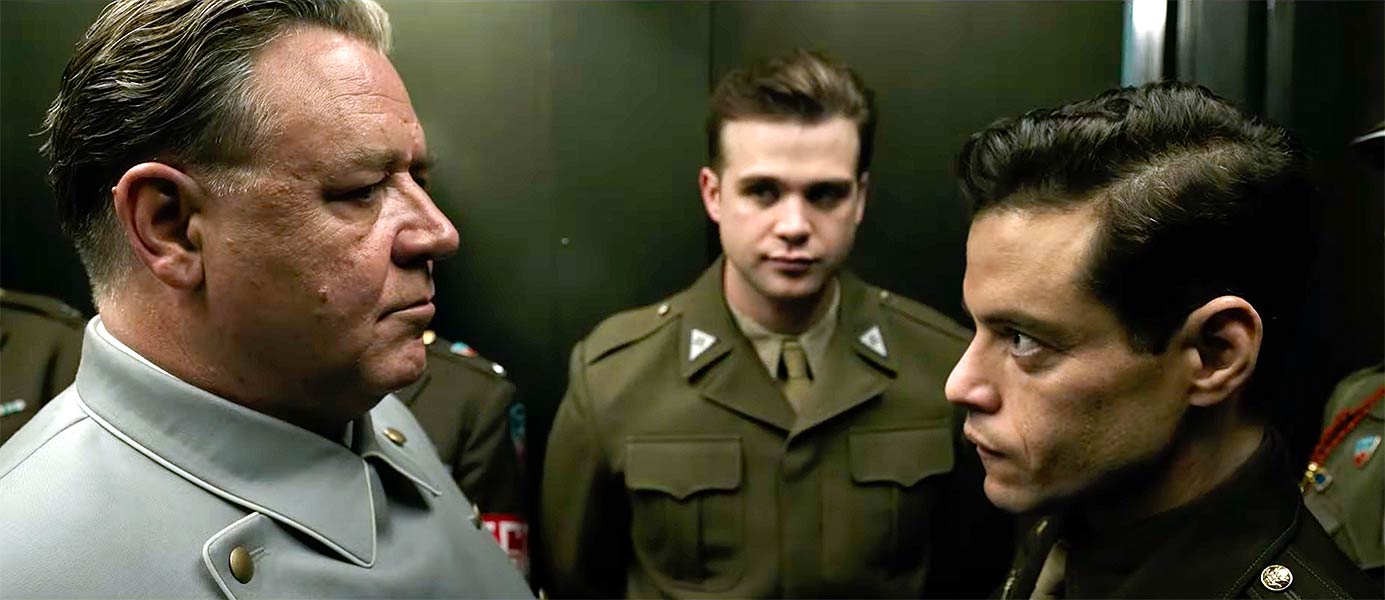
For the blossoming US History High School students, the Nuremberg trials are a landmark event in World History. Post World War 2, Robert H. Jackson (Michael Shannon) risks his Supreme Court Nomination for a new idea. With the help of British lawyer David Maxwell Fyfe (Richard E. Grant), Jackson pulls together all 4 Allied Powers (US, UK, France, Soviet Union) to put the remnants of the Nazi High command on trial. To bury Rudolf Hess (Andreas Pietschmann) and Hermann Goring (Russell Crowe) legally, Jackson realizes he has to understand these guys intimately. So he deploys psychiatrist Douglas Kelley (Rami Malek) and translator Howie Triest (Leo Woodall) to spend as much time as he can with these Nazis, to really understand how these “evil” men tick.
Vanderbilt’s film certainly is ambitious. This 2 and a half hour epic dives deep into the timeframe right after the Europe part of the war ends, through the Trials themselves. Largely inspired by the book about the Goring/Kelley relationship, the biggest chunk of the film is built around Rami Malek and Theo Woodall vs. Hermann Goring in a battle of wills. I don’t think Rami Malek can rise fully into his role here, but Russell Crowe and Theo Woodall help carry the moments when Malek can’t quite deliver what the movie needs him to. And they’re not alone: in order to tell the story properly, Vanderbilt weaves in the details of Jackson and Fyfe’s efforts to convince the Allies to proceed with and bring the trials to the public, a bit of Goring’s family life, other Nazi High Command characters like Rudolf Hess, and various other military members like John Slattery’s commandant of the prison. Not all the subplots work (the journalism section is unnecessary), but in general, hiring a bunch of great character actors to elevate some of the broad strokes material in Nuremberg goes a long way to make the movie feel important, and even at times find incredible moments, like a Woodall Speech and an incredible Shannon moment with the Pope.
But that’s a LOT of people and parts that need their moments. Nuremberg feels like Vanderbilt was so excited filming the psychological scenes in the prison, he forgot he had to stage one of the most important, filmed moments in world history. The trial should be the culmination of this dense layered storytelling the director’s been concocting. Instead, it becomes a rush to essentially finish Rami Malek’s storyline, because he’s barely a side character for the Nuremberg Trials. In that rush the movie doesn’t quite land the plane on how Douglas’s work was used to sign Hermann Goring’s death sentence. It’s always a delight to see justice served, but in this case, that justice feels unearned by the previous 2 hours of commitment the audience put in, leaving just a mildly off-putting taste in our mouths as we leave. That taste grows more foul as we then swerve back to Malek’s Douglas as the final capper for the movie, which time jumps through years of character arc to end up at the end Vanderbilt wants. For the movie version of Nuremberg, James Vanderbilt needed to either make the story about Douglas Kelley, or Hermann Goring. He chose the middle ground, which needed a mini series, not a movie, to tell Nuremberg’s story properly.
But there’s still a lot to love here. I admire what Vanderbilt is attempting to do, especially in trying to explain to people today why these trials were important. Anyone can execute someone, but to win in the court of ideas, that’s where the real winners live. Due process for the win!