
De Niro and Scorcese. Mifune and Kurosawa. Denzel and Spike. Emma and Yorgos. These are some of the best actor/director pairs in cinema history. One that belongs right alongside them is Ethan Hawke and Richard Linklater. Usually they share the spotlight when they put out something amazing. This time, Rick gives Hawke the spotlight…playing a man who’s about to lose his own very, very soon.
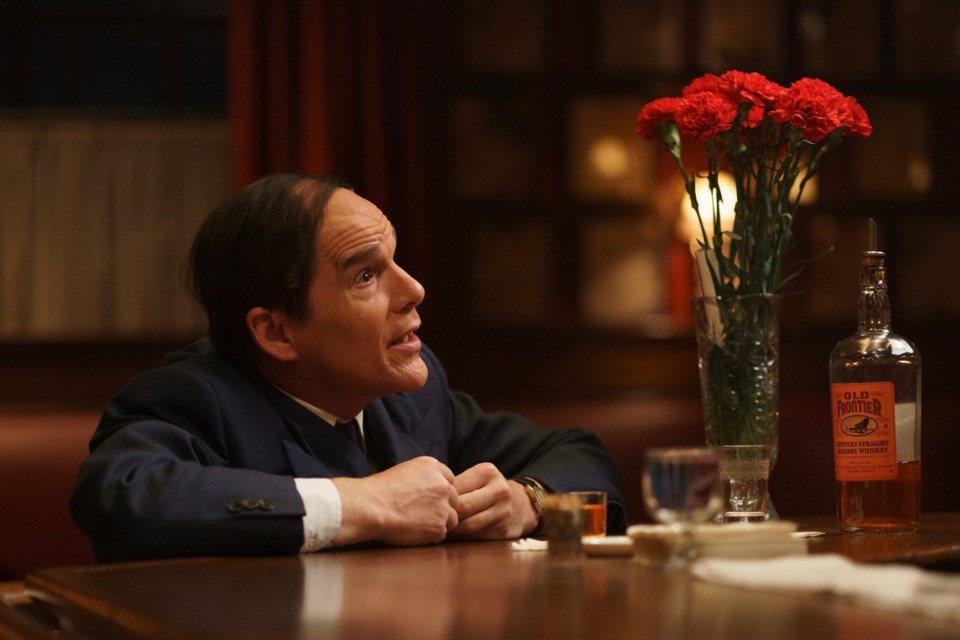
That man is Lorenz Hart (Hawke). From the 1930s to mid 1940s, Hart was part of the amazing play/songwriting duo Rogers and Hart. Yes, Richard Rogers (Andrew Scott). You all might know RR as part of Rogers and Hammerstein (Simon Delaney). Blue Moon takes place on the night that switch happened: March 31, 1943, the opening of Rogers and Hammerstein’s Oklahoma! (ugh an exclamation point?!?!). But Linklater’s movie follows Hart, who walked out of the play, knowing it was gonna be a megahit, ready to drown his sorrows at Sardi’s in New York City. Telling bartender Eddie (Bobby Canavale), random bar patrons (Patrick Kennedy), and Hart’s latest young female infatuation Elizabeth Weiland (Margaret Qualley), his two cents on the situation.
The reason I love Richard Linklater and Ethan Hawke as a pair is the two pick the best choice creatively at all times. For Richard Linklater, this time, that means he’s supposed to direct Blue Moon like the audience is there with Lorenz Hart at Sardi’s on March 31st. All Linklater’s creative energy went to establishing the movie’s vibe, the director’s great strength. By minute 10, I was instinctually grabbing for a drink I wasn’t having; I was sitting to the right of Lorenz Hart as he waxes poetically, sadly, amusingly, about what has befallen his life while the bar pianoman (brilliant idea Rick!) drops Hart’s best songs in the background, transfixed at one of my favorite actors doing his thing. In a career of amazing performances, this one is as good as anything Ethan Hawke has ever done, commanding the screen with just the gift of his gab and ability to emotionally transform as the movie needs him to scene to scene. I was equally as compelled with him regaling the bar with his stories as I was watching him desperately try to get even little pieces of Rogers’s or Elizabeth’s time when they arrive at Sardi’s.
With no Julie Delpy around, Linklater and Hawke get help from a third, silent partner. Hawke’s greatness is elevated by one of the best screenplays of the year. Robert Kaplow, a writer/retired English teacher, was the perfect seamless collaborator. First off, he knew Richard Linklater, who adapted one of Kaplow’s books. But more importantly, Kaplow adored those plays and songs from Hart: game recognizing game if you will. So if we’re gonna celebrate the social death of Lorenz Hart, he’s gonna go out in style..with some Bacardi in tow. And also, some of the other great artists of the era? I mean this is all wish fulfillment right Robby? One of the best sequences in the movie is when Hart notices a guy sitting in a booth nearby, who happens to be a famous writer of the era. That person’s presence adds a wonderful richness and depth to the movie that otherwise wouldn’t have been there, thanks to Kudlow’s personal fantasies coming together for all to enjoy. Blue Moon is wonderful reminder that you don’t need explosions or violence for a movie to be magic; you just need a great story from a great writer, which Robert Kaplow is.
I was never an Anglophile like my parents, and their Downton Abbey obsessions. I am instead a Linklaterphile. A man who knows something special can happen at any time, if your heart and mind are open to it. I already visited Vienna and Texas because of Rick; Sardi’s is gonna be next on my list. I hope Ethan Hawke is just sitting in the corner, ready to tell another incredible tale.