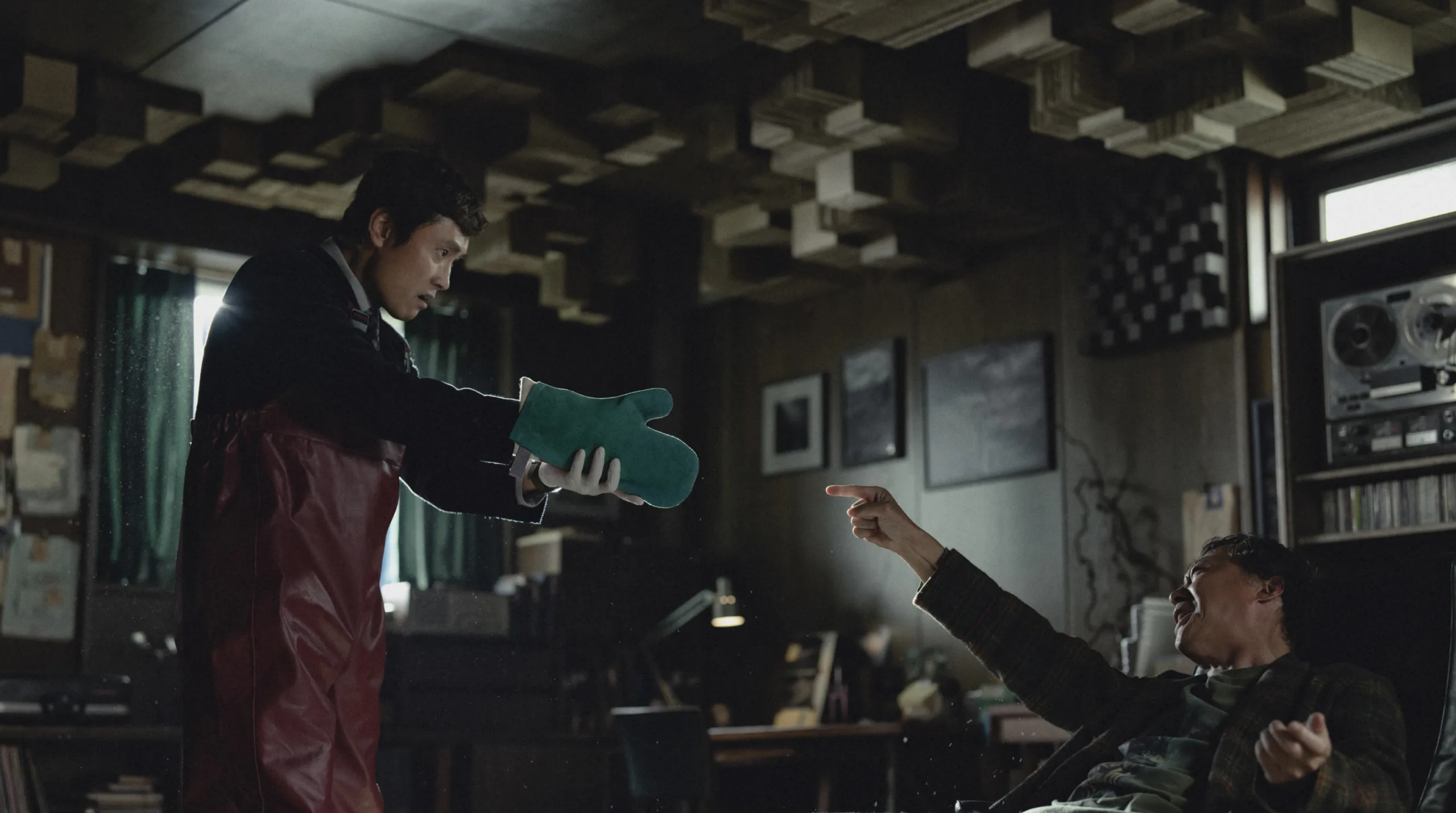

The last time a great Korean director addressed how capitalism has affected his country, we got Parasite, one of the great films of the last decade. Park Chan-wook has to deal with those lofty expectations when he announced what No Other Choice was about, with the Squid Game guy. Park’s latest isn’t one of the best films of the past decade, sadly. But when it’s humming….whoa, its as good as anything in 2025. You can write that on paper.
In Man-su’s (Lee Byung-hun) case, Solar Paper. We see early on that career as a papermaker has let him buy his family’s home, marry the love of his life Lee Mi-ri (Son Ye-jin), and have Si-one (Woo Seung Kim) and Ri-one (So Yul Choi) two beautiful kids with two loving dogs. You know, the ideal adult life. But that delicious octopus he was sent…is the octopus of doom. Solar Paper’s new American owners (ha, well done) are laying him off, threatening that entire existence. Months of unemployment makes Man-su desperate for some new paper to make. Moon Paper appears to be his last chance to save his perfect life, but Man-su figures out he’s got the third best resume behind other laid off paper workers Goo Beom-mo (Lee Sung-min) and Ko Si-jo (Cha Seung-won). How does one go from third to first with less experience? If you’ve seen a Park Chan-wook movie, you know what Man-su is going to do.
No Other Choice on its surface would seem like perfect Park material: desperate frail man hoping to regain his masculinity through violence and manipulation. In practice, it’s in inartful fit. The good stuff: Man-su’s descent from the mountaintop is wonderfully Chan-wook: it’s all societal cuckholding for Man-su: self-help seminars preaching to yourself you matter, cutting back on hobbies like Mi-ri’s tennis or Ri-one’s cello, Mi-ri has to get part time work from a super hunky young dentist Oh Jin-ho (Yoo Yeon-seok), and emasculating job interviews where he’s mocked by younger manager Choi Seon-chul (Park Hee-soon). Lee Byung-hun uses that Squid Game experience to pretend to be on the other side of the aisle, holding none of the card, quietly crying for help with no one really listening. I also really like Man-su’s plan, using clever hidden ways to figure out all the information he does, and deducing who to target. The smaller, buildup parts of the movie are a wonderful fusing of the best of Park and capitalist critique No Other Choice wants to be.
But inside of brilliant filmmaker Park is lurid Park Chan-wook. And that part takes over too often as Man-su’s plan kicks into motion. That could be the point: Man-su’s bad qualities mean his “perfect” plan is going to go awfully. But the way Park chooses to have Man-su’s plans go haywire is…very strange, but very him. There’s so many dangling plot holes after each new encounter that credulity starts to stretch a bit on the margins, taking you out of the movie a little. I sense Park had his ending in his head, and had to find a way to get there, but gets a bit lost in the middle. That doesn’t mean there aren’t great moments along the way: there’s a dance number (yes, really) that’s totally darkly silly magic, and the final sequence is wonderfully wicked and clever, capturing that deep part of humanity we don’t like to think is there, and are afraid to find out that it might actually be.
Alas, Parasite remains the top of the South Korean movie heap. I wonder how I will feel about No Other Choice as time goes on. It’s certainly got greatness inside of it, but enough other parts that keep me from praising it as a masterpiece. Ah! Park, you devil. Maybe that’s it…we’re all human, so just embrace it. Or when a job comes along you want, just murder the best candidates. Either message is acceptable I guess.
Man-su’s journey really highlights how quickly everything can unravel in the face of corporate greed. It’s a sobering reminder that even the most stable lives can be upended by forces beyond our control.