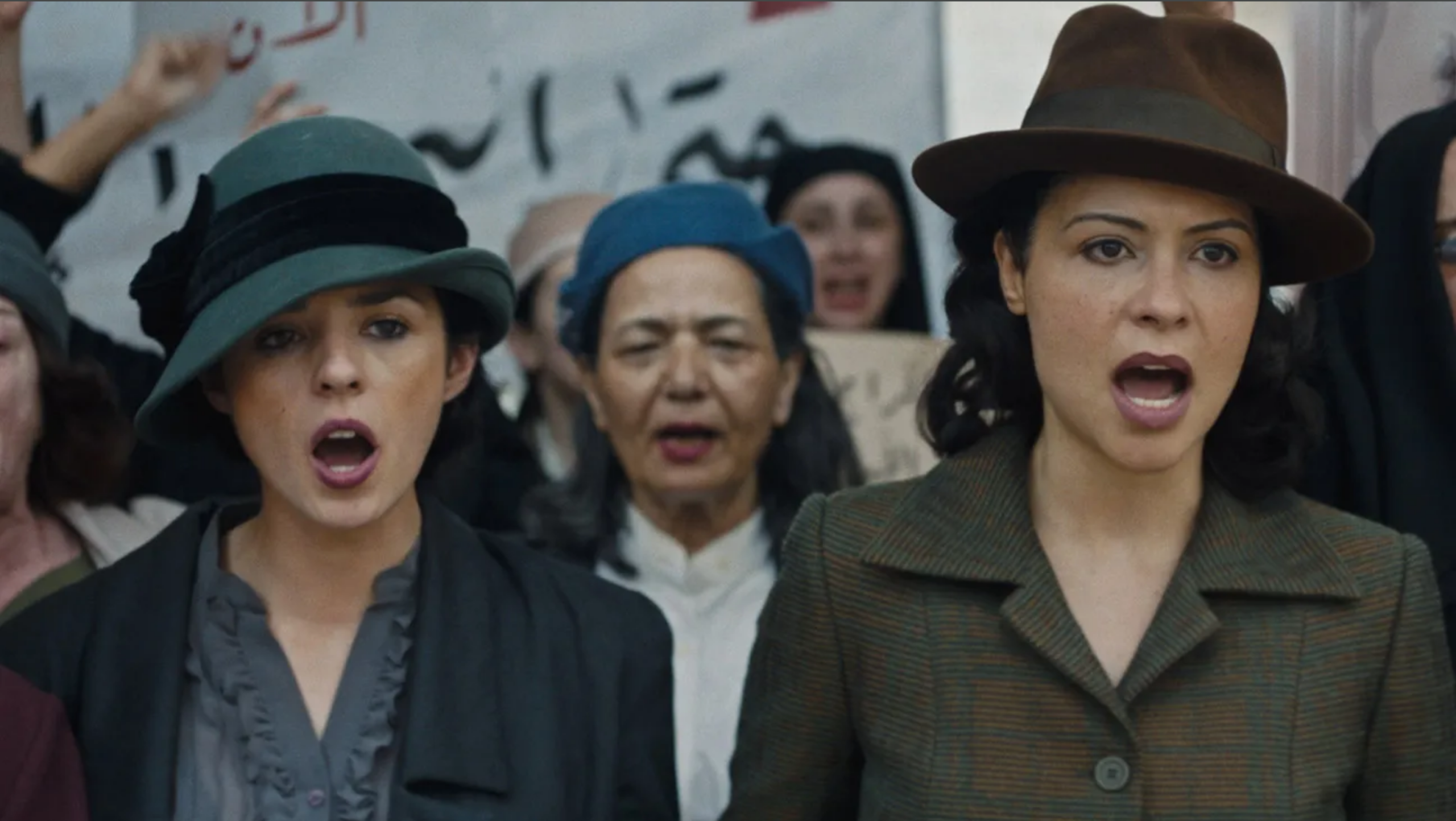

Winston Churchill gets credited with saying “History is written by the victors,” himself stealing that phrase from a bunch of losers. It’s really sad…but true, making sympathetic people wonder what the losing perspective was, and brave historians uncovering tales like the Trail of Tears or the racist destruction of Black Wall Street. Palestine ’36 is another one of those tales, just in movie form, telling an additional story that when I read about it in history books only praised the recreation of the Jewish state of Israel after the Holocaust.
Never considering who might have lived there since the Jews were thrown out by the Roman empire: the Palestinians. In 1936 we meet Yusuf Bassawi (Karim Daoud Anaya) arriving in Jerusalem to work for his family in well regard by the British regime there, Amir (Dhaffer L’Abidine) and Khuloud (Yasmine Al Massri) Atef. Yusuf vacillates between the city life and the small rural village where he’s seen as a star citizen by elders like Father Boulos (Jalal Altawil), Hanan (Hiam Abass), Abu (Kamel El Basha), and Abu/Hanan’s daughter Rabab (Yafa Bakri). But this is a BAD time to be a Palestinian. British rulers like High Commissioner Arthur Wauchope (Jeremy Irons) uses brutal Captain Orde Wingate (Robert Aramayo) to enforce the UK’s desire to set up a joint Jewish/Arab state, willing to displace many Palestinians to achieve that goal before Germany’s Nazi party really starts enacting their vile plan.
In 5th grade you’re just never gonna ask the question but what about the people who lived there when the history books talk about the rise of Israel. Annemarie Jacir’s movie, though fictional, presents what was likely a pretty realistic case of what happened to the Palestinians as more and more Jews started returning from Europe. We open on ships arriving, as well as the first radio broadcast to the region, indicating the little world Palestinians were living in is about to get much bigger. Little by little we see the small compromises that let us get to that 1948 coronation of the Jewish State…at the expense of these Arab communities. Land ownership isn’t clearly defined; the Brits start moving Jewish refugees in on some of the land and build walls around it for “protection.” Quiet sidelined Palestinian union workers like Khalid (Saleh Bakri) start getting replaced by Jewish cheap labor, forcing them to become radicalized to fight against British rule. This angers the Brits, who respond by bringing in Captain Wingate to “restore order.” to these communities who’d rather be left alone and peacefully farm. Writers like Khuloud get infiltrated by pro Zionist journalists to spread propaganda for the Brits/Jews confusing everyone. More land gets taken, and now more generations of people on both sides get radicalized and start to escalate and fight one another. Each action/reaction Jacir raises the stakes and perspective, as this story encompasses more and more of the Palestinian population, including for example Christian believes like Father Boulous who aren’t written about ANYWHERE in the history books, because that goes against the popular “narrative” of these “bad anti-Semitic Muslims who rebel against the proper Brits and Jews.”
Even though we have Jeremy Irons and Liam Cunningham on hand, its the wonderful Arab cast that really makes you feel the hurt of the Palestinians in 1936. Each cast member is playing the role of important Palestinian society members so the audience can put a human face on a vast persecution. The women in particular stand out; I loved Kholoud’s fight through the press and high society, using British beliefs against them with knowledge, while also using that writer/journalist mind to snoop inside her own house to see if she’s fighting multiple battles at once. The triple threat of grandma Hanan (Hiam Abass), daughter Rabab (Yafa Bakri), and granddaughter Afra (Wardi Eilabouni) makes us understand the changes that happened across 3 generations: elders lost everything they built their lives for, younger kids lose innocence and become radicalized, and mom’s in the middle get both at once, carrying the emotional burden and moving on. Karim Daoud Anaya and Ward Helou do justice by the men too, going through their own journeys from boys into men in different ways and routes, as writer/director Jacir makes sure her main players aren’t just archetypes: they have journeys from point A to point B as the mandate for dual statehood grows and grows, transforming from strong to weak, weak to strong, etc as the story dictates.
So consider Palestine ’36 your deep cut history lesson. We don’t hear from the losers of a war very often, but as one of the great Firefly quotes goes: “May have been the losing side. Still not convinced it was the wrong one.” Always a good lesson for everyone to consider. And one I hold deeper and deeper the older I get.