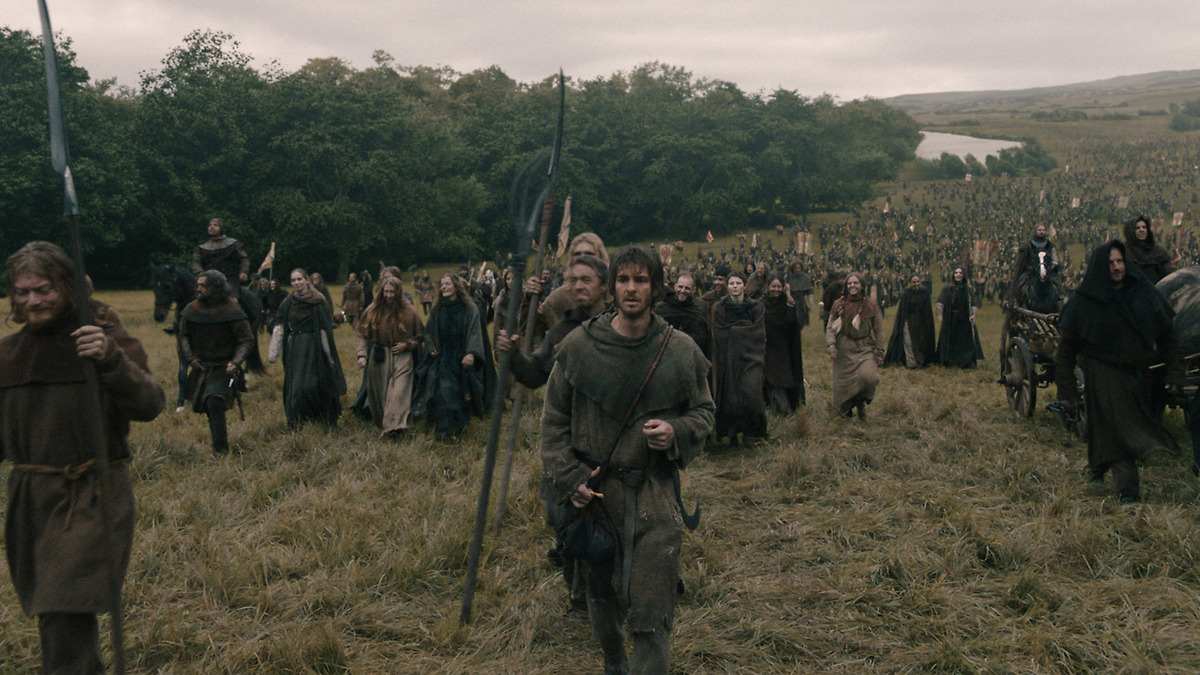

The Uprising wins the most frustrating Almost Award of 2026. I see Paul Greengrass’s enthusiasm for the story, and even the bevy of themes and plots he wants to take the movie in. There’s a great movie in here somewhere, it’s just not this one.
We’re in 1381 England, where a very young King Richard II (Woody Norman) is having daily nightmares and too afraid to govern. As such, his advisors like Bishop Simon Sudbury (Stephen Dillane) and Grand Prior Sir Robert Hales (Tom Hollander) assume leadership of the country. Sensing loss of money, the advisors levy a tax on the population. But with tensions already high from the plague, a ploughman (Andrew Garfield) decides enough is enough, and refuses…with force. Turns out, everyone’s a little pissed off, including a poor priest John Ball (Jamie Bell) and former English military officer Wat Tyler (Cosmo Jarvis), who combine forces and decide to escalate their rebellion…all the way to London.
Even though the Ploughman is clearly Robin Hood, that doesn’t mean it’s not a good idea to tell his tale in our current time and age. But trying to fit 1381 England into 2026 USA is a bit of a squarish peg/roundish hole situation. When it’s right it’s bangin: giving the king advisors and letting them rule is a perfect modern twist that works. And the struggles of controlling the anger of your followers foretells of modern equivalents to contemporary times. However, the parallels are only right half the time. There’s lines of dialogue ham fisted inserted to draw a rise out of the audience, but are so on the nose they don’t even fit into the scene we’re watching. While a fire is burning somewhere, a character out of nowhere goes “Yeah those guys were scared the deplorable Flemish were gonna take their jobs.” Now that might have been said in 1381, but is more likely there for 2026.
Same idea goes for Paul Greengrass. The king of the shaky cam brings it out early and often in The Uprising. Now, the battles and intense negotiations need this immediacy, making each fight or deliberation infinitely more tense and exciting as the camera immerses us into the fight. But uprising’s start slow. Watching the camera dance around Andrew Garfield as he’s just deliberately plowing his field is distracting and disorienting, and frankly makes it feel like a first time director shot this movie. As for his story, he throws a lot of subplots in the air: rich vs. poor, power and money, maintaining a rebellion, diplomacy vs. violence, etc. Historically, he has to get the story to the real life big finale (which is hella fun and well made). But that ending is incongruous with many of his subplots. Instead of leaving The Uprising intentionally messy, Greengrass tacks on a tidy epilogue ending that’s so rushed and out of place compared to his movie it never lands the way he hopes it does.
But it’s all good. The Uprising means well, and does right by its leads who give it their all. Although, what’s going on with Andrew Garfield’s movie career? I love his choices on paper but nothing truly great has come from them; in fact, a few disasters are in there. Hey UK/Hollywood, let’s not waste one of our great actors please?